
Since I launched my Substack a few months ago, I’ve been using this platform to share my research into Elizabeth Boleyn, but today, I wanted to announce my next book — a biography of Perkin Warbeck, remembered so many as Richard, Duke of York. Anyone who follows me on Instagram will already know that this is my current research project, because I’ve been sharing posts about it lately, but I wanted to use this post to discuss the project in more detail, and why I felt it was time for another biography of Warbeck.
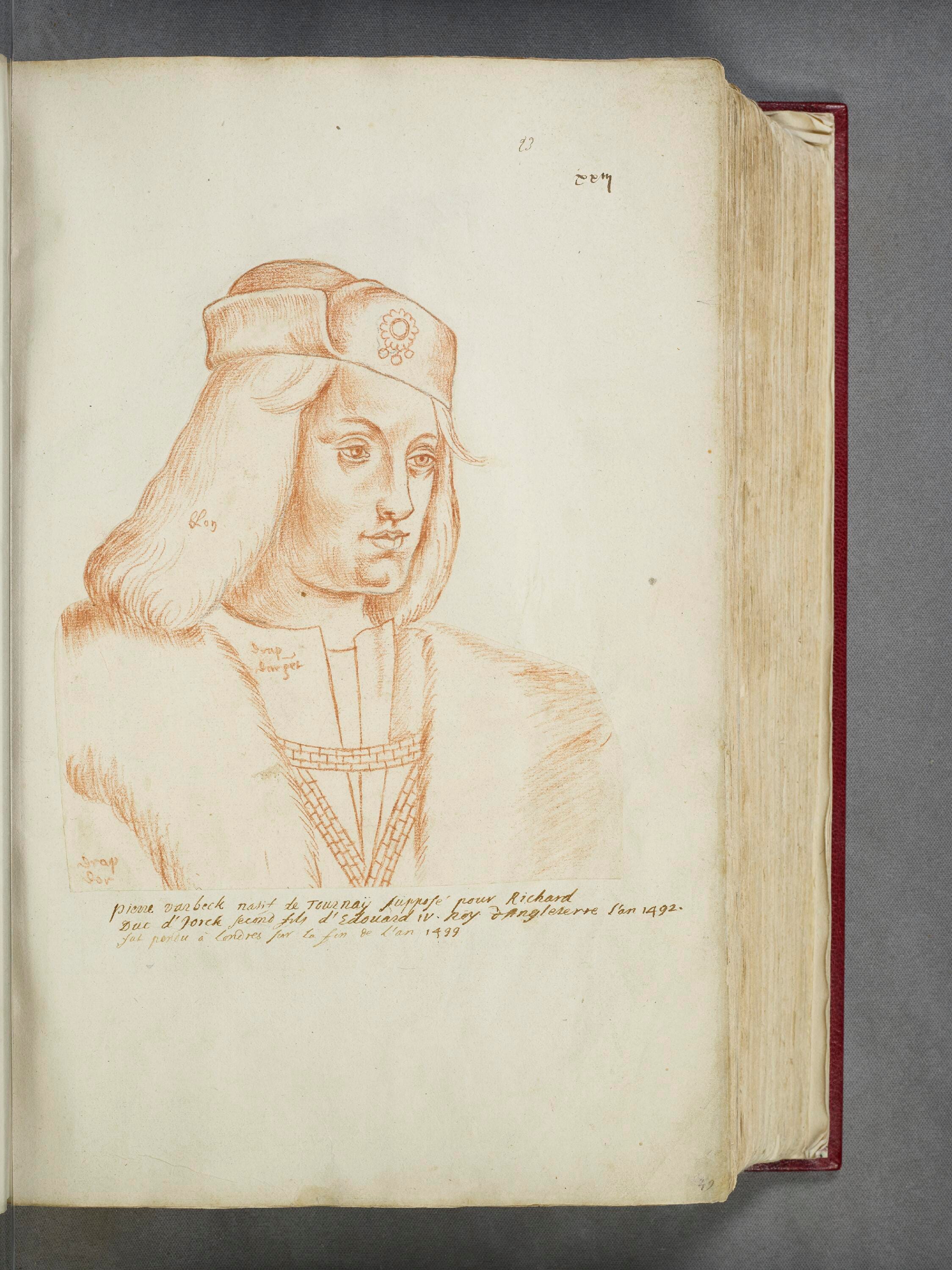
Who was Perkin Warbeck?
If you’re reading this post, I’m almost certain you know who Perkin Warbeck was, but as a summary, Warbeck was a young man from Tournai who appeared in Cork in Ireland in 1491. He is famous for claiming to be Richard, Duke of York, the younger son of Edward IV, who had disappeared from the Tower of London in 1483.
If you believe he was an imposter, then you believe he was the son of a “boatman” from Tournai, forced to play the role of Richard, Duke of York. If you believe he was Richard, Duke of York, then he was actually the rightful heir to the English throne.
He gained royal support across Europe, initially from Charles VIII, then from Margaret of York (the aunt of the undisputed Prince Richard), Maximilian I, and James IV. Financed by them, he tried to invade England three times before he was finally captured at Taunton in October 1497, and held at the Tudor court as a public spectacle for two years, until he was hanged in November 1499.
During his life, and ever since his death, his identity has caused a lot of interest. Was he really the son of Edward IV, or perhaps an illegitimate son? How could the common son of a “boatman” convincingly play the role of a prince? People on both sides of the debate feel very strongly about their beliefs, and lately, the weight of public opinion seems to have swayed towards the idea that he was Richard, Duke of York. However, academics (myself included) still believe that he was an imposter. This is the story I will tell in my book.
The genesis of this project
This book actually originally began as a biography of Katherine Gordon, Warbeck’s Scottish wife. I wanted to focus on a famous story, but centre an overlooked woman, the way I did when I wrote my first book about Elizabeth Boleyn.
However, I realised quickly that there wasn’t enough on Katherine to sustain a full biography, and Warbeck himself was too intriguing to ignore. For a while, I attempted a social history of Katherine Gordon, in which I charted her story from contemporary sources through to the present day, in poems, plays, and eventually, TV depictions. While there is definitely enough there to sustain a whole book, again, Warbeck’s story just kept drawing me in.
Eventually, I decided to just focus on what I wanted to write about, and started writing this book in earnest. Therefore, I’ve spent roughly the last two years on and off researching and reading around this subject, but I’ve only begun researching and writing again very recently.
Why another biography of Warbeck?
The subject of the Princes in the Tower has never disappeared from public consciousness, so you might be surprised to know that there have only been six dedicated biographies of Perkin Warbeck in the last 36 years:
Richard of England by Diana Kleyn in 1990
The Perkin Warbeck Conspiracy, 1491-1499 by Ian Arthurson in 1994
Perkin: A Story of Deception by Anne Wroe in 2003
The Survival of the Princes in the Tower by Matt Lewis in 2017
Henry VII and the Tudor Pretenders: Simnel, Warbeck, and Warwick by Nathen Amin in 2020
The Princes in the Tower: Solving History’s Greatest Cold Case by Phillipa Langley in 2023
Of these, three claim that Warbeck was Richard of Shrewsbury (Kleyn, Lewis, and Langley), two claim that he was an imposter (Arthurson and Amin), and one hedges their bets, but definitely casts doubt over the traditional “imposter” narrative (Wroe).
Some of these aren’t traditional narrative biographies either. Lewis’ book tells Warbeck’s story alongside the story of the Simnel uprising, making a case that Warbeck was Richard of Shrewsbury, and the Simnel rebellion was in favour of Edward V. Amin’s book tells Warbeck’s story through the lens of Henry VII’s response to it. Langley’s book presents evidence uncovered by the Missing Princes Project, but doesn’t tell the story of Warbeck’s life from his birth to his death.
There hasn’t been a traditional biography focused on Warbeck since Anne Wroe’s book in 2003. Wroe introduced the Setubal Testimonies into the academic conversation — these were a series of interviews given in 1496 by Portuguese knights who knew Warbeck during his time at the Portuguese court. Wroe also used Warbeck’s French confession as a source, but she cast serious doubts on its veracity. This post isn’t the place for me to discuss Wroe’s arguments in full, but in short, I am going to challenge a lot of her claims.
Since the rediscovery of the Gelderland Document and other important primary sources by the Missing Princes Project, there has not been a biography of Warbeck which utilises all of the available evidence on both sides of the debate — his French and English confessions, given in 1497; the letter to his mother he wrote in October 1497; the Dendermonde Letter, written in 1493; the Setubal Testimonies, drawn up in 1496; and the Gelderland Document, drawn up in 1493.
I am also working with several incredible scholars who have kindly agreed to translate key primary sources. Here, I must shout out Marlou van Gendt, Estelle Paranque, Suzannah Lipscomb, and Heather Darsie, all of whom have generously offered to lend their linguistic expertise. This project is multilingual, and not something that I could ever hope to attempt by myself. I’m so grateful for the support I’ve received in embarking on this huge task.
There has also not been a narrative biography telling the story of the imposture since Arthurson’s book in 1994. If nothing else, I think it’s time that another historian looks at the primary source evidence and tells this story.
Conclusion
The subtitle for the 2025 paperback of The Princes in the Tower by Phillipa Langley was changed from Solving History’s Greatest Cold Case to How History’s Greatest Cold Case Was Solved. With newly-discovered evidence included, the paperback confidently claimed that the mystery of the Princes in the Tower’s disappearance was solved, and Perkin Warbeck was Richard, Duke of York.
I could not feel more strongly that this is not the end of the story. History is never “done”. New discoveries, new angles, new translations, new questions, all add to our understanding. When Diana Kleyn was writing in 1990, the Setubal Testimonies had not been rediscovered. When Nathen Amin was writing in 2020, the Gelderland Document had not been rediscovered. New documents shape our understanding of history, and new historians ask different questions with each generation.
This project will obviously take years. Primary sources will need to be translated. I will need to travel to places Warbeck visited. I will need to actually write the book! This is a huge undertaking, but one which I am very excited about. I wanted to make this quick post to discuss my current research project! I know this is a departure from my usual type of Substack post, but I hope subscribers won’t mind.
If you’re interested in my following my research, or reading more about my other biographical subject, Elizabeth Boleyn, please do consider subscribing to my Substack and following me on Instagram and Bluesky.
A fantastic project Sophie and no doubt a lot of work ahead! I'm looking forward to reading your book when it's finally published. I'm also looking forward to updates along the way. I'm sure new evidence will come to light while you're working on this.
Interestingly Katherine Gordon later married into the wider family of the man who captured her in Cornwall - my ancestor Giles Daubeney!
I look forward to your book and share your view that Warbeck was an imposter. Daubeney who knew Richard from birth also thought so.